Google Maps Shortcuts Risk Local Businesses

CTR manipulation sends automated or low-quality traffic to a Google Business Profile. Those fake interactions
Click-through rate manipulation and other Google Maps ranking shortcuts create long-term risk by triggering spam-detection penalties, sometimes called "Google Jail," that suspend visibility entirely. Rankings built on fake engagement signals collapse once Google updates its algorithm. Businesses lose leads overnight. Compliant, protected-territory optimization builds visibility that survives algorithm changes instead of disappearing with the next update.
Key Takeaways
Google Maps CTR manipulation artificially inflates engagement metrics, triggering algorithmic penalties that tank local visibility long-term.
Fake click patterns violate Google's core ranking policies; businesses face delisting, profile suspension, or permanent search removal.
Manipulated CTR signals train your visibility system to optimize for false metrics instead of genuine customer acquisition and conversion.
Short-term ranking gains collapse within 60-90 days as Google's detection systems identify and reverse artificial engagement patterns.
What makes Google Maps shortcuts risky?
Google Maps shortcuts risk begins when a business artificially inflates engagement metrics on a Google Business Profile. Click-through rate (CTR) manipulation is the practice of faking user signals like direction requests, profile visits, and clicks to trick Google into ranking a listing higher. The logic sounds appealing for a business struggling to get found. The real-world consequences are not.
How does CTR manipulation actually work?
CTR manipulation sends automated or low-quality traffic to a Google Business Profile. Those fake interactions register as engagement. Google's algorithms read high CTR and interpret it as relevance. The listing gains a temporary visibility spike.
Why do the consequences outweigh any ranking gain?
The short-term ranking boost collapses when Google detects the pattern. Manual action penalties follow. A suspended or suppressed profile loses all local search visibility with no guarantee of reinstatement. The time and revenue lost during recovery far exceed what a compliant strategy would have cost. Local SEO fake engagement risk is a gamble where the house always wins.
What separates a sustainable alternative from a shortcut?
Sustainable Google Business Profile optimization relies on real signals from real customers. Authentic reviews, accurate citations, relevant content, and genuine user interactions build durable local search visibility incrementally. We do not chase quick wins that violate Google's guidelines. We build growth operating systems that deliver business outcomes without risking the listing itself. That is the only Google Business Profile optimization strategy with a predictable future.

Fake engagement signals to Google that a listing is more popular than it actually
How does fake engagement hurt your business?
Fake engagement signals to Google that a listing is more popular than it actually is, creating a distorted picture of real customer behavior. This practice, known as CTR manipulation, artificially inflates metrics like direction requests, profile clicks, and phone calls. Google’s algorithms detect these patterns over time. When they do, the consequences are severe.
Google Maps shortcuts risk becomes a liability rather than a shortcut. The temporary ranking boost disappears. What remains is a damaged reputation with both Google and potential customers who encounter inconsistent information. A business that relied on fake signals now faces a harder climb back to authentic visibility.
What happens when Google detects manipulation?
Google applies penalties that can include suspension or removal from local search results entirely. The business loses the trust it spent years building. Recovery requires a complete Google Business Profile optimization strategy built on compliance, not deception.
How does Bizynk prevent this outcome?
We build durable local search visibility through continuous monitoring and automated optimizations that follow Google’s guidelines. Our system catches suspicious activity before it becomes a problem. We replace local SEO fake engagement risk with authentic local SEO growth that compounds over time.
Google Maps ranking factors like reviews, proximity, and relevance are improved naturally
Sustainable Google Business Profile optimization happens through real customer engagement
Every optimization passes Google’s quality standards automatically
The result is visibility that lasts. No penalties. No recovery periods. Just consistent growth built on real signals.
Google Maps rankings rest on a blend of relevance, distance, prominence, and genuine user engagement
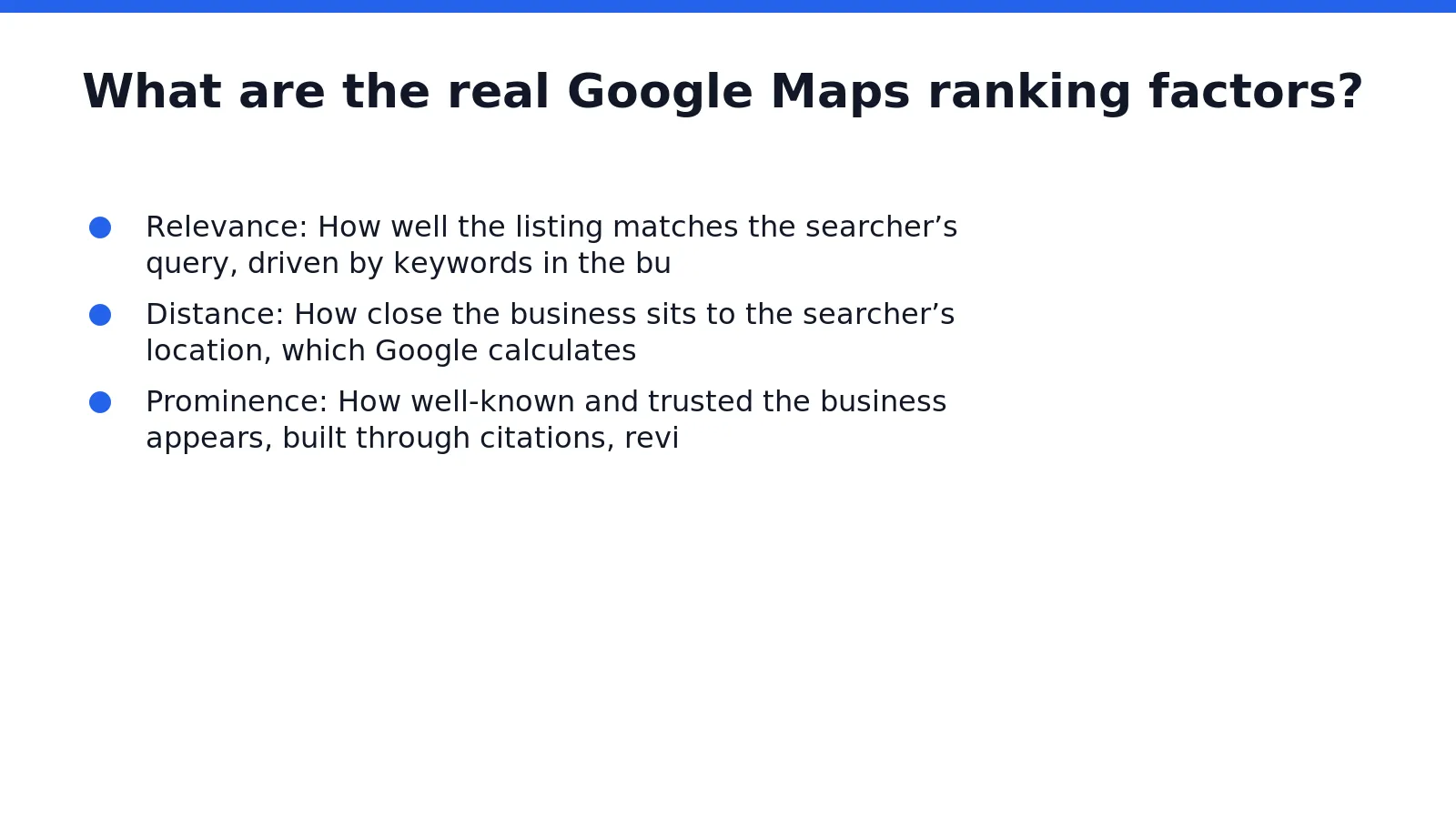
What are the real Google Maps ranking factors?
Google Maps rankings rest on a blend of relevance, distance, prominence, and genuine user engagement signals, not on any single shortcut. Google’s algorithms heavily weigh user engagement metrics, such as click-through rate (CTR), when determining the ranking order of local business listings. A listing with a higher CTR is perceived as more valuable and relevant, which pushes it higher in the Maps results. That perception, however, only counts when the clicks come from real people acting on authentic intent.
Google Maps shortcuts risk permanent penalties when they rely on fake engagement. CTR manipulation, for instance, artificially inflates clicks to trick the algorithm into thinking a listing deserves a boost. That tactic can produce a temporary elevator, but Google’s spam systems eventually detect the pattern. When they do, the business loses its hard-won positions, and recovery takes months of rebuilding trust.
Sustainable Google Business Profile optimization starts with the factors that actually move the needle. The core Google Maps ranking factors break down into three categories:
Relevance: How well the listing matches the searcher’s query, driven by keywords in the business description, categories, and services.
Distance: How close the business sits to the searcher’s location, which Google calculates from the user’s device and the listing’s address.
Prominence: How well-known and trusted the business appears, built through citations, reviews, and consistent NAP data across the web.
Local SEO fake engagement risk extends beyond CTR tricks. Buying reviews, using click farms, or automating profile actions all violate Google’s guidelines. Each violation carries the same consequence: a manual action that strips visibility, often without warning.
Google Business Profile optimization strategy that lasts focuses on accurate citations, consistent NAP data, and authentic reviews. Those elements signal trust to Google’s algorithms, and they build a foundation that survives algorithm updates.
Durable local search visibility comes from compounding effort, not hacks. Authentic local SEO growth means earning clicks, calls, and direction requests from people who actually want your service. That engagement tells Google the listing deserves its rank, and it holds up over time.
Recovery from a Google Maps penalty is possible. It demands a complete reversal
Can you recover from a Google Maps penalty?

Recovery from a Google Maps penalty is possible. It demands a complete reversal of the tactics that triggered the penalty in the first place. Google Maps shortcuts risk permanent damage when they rely on fake engagement signals like manipulated click-through rates. The platform's algorithms detect these patterns, and the resulting penalty strips visibility from the local pack entirely.
How does the recovery process actually work?
The first step requires removing every trace of artificial activity. Local SEO fake engagement risk means any bot-driven clicks, automated searches, or coordinated interaction must stop immediately. Google's systems continue monitoring behavior after a penalty, so continued manipulation extends the recovery timeline indefinitely.
Once the fake signals are eliminated, the business must rebuild trust through legitimate activity. Sustainable Google Business Profile optimization focuses on real user engagement: accurate business information, genuine customer reviews, and consistent citation accuracy across the web. This signals to Google that the listing deserves reinstatement.
What role does ongoing monitoring play?
A Google Business Profile optimization strategy without monitoring leaves the business vulnerable to repeat penalties. Our Intelligence engine tracks rank drops and site errors continuously, enabling rapid response to any ranking issues before they compound. This proactive approach prevents the slow erosion of visibility that follows undetected problems.
Durable local search visibility comes from consistent optimization, not short-term manipulation. Authentic local SEO growth follows a predictable path: fix the fundamentals, earn real engagement, and maintain vigilance. Penalties teach a hard lesson, but businesses that commit to this path recover their position and keep it.
How do you build authentic local SEO growth?
Building authentic local SEO growth requires a system that combines search optimization, AI visibility, technical fixes, and content strategy into one compliant framework. Shortcuts like CTR manipulation create local SEO fake engagement risk that can trigger penalties and destroy durable local search visibility. We build growth that lasts by aligning every action with Google's guidelines.
What does a compliant local SEO system look like?
A compliant system automates the right work without cutting corners. Our Growth OS package handles CMS publishing, site monitoring, and lead capture automatically. The system identifies technical issues, deploys fixes, and keeps content flowing. Marketing runs on its own schedule. Leads get followed up without delay. Every system stays connected.
How do you avoid Google Maps shortcuts risk?
Avoiding Google Maps shortcuts risk starts with understanding the Google Maps ranking factors that actually matter. Google weighs user engagement signals like click-through rate when ranking local listings. A higher CTR signals relevance. But artificially inflating that metric through bots or click farms violates Google's terms. The penalty can erase months of ranking progress overnight.
Our Google Business Profile optimization strategy focuses on real signals:
Complete and accurate business information
Genuine customer reviews and responses
Consistent citations across directories
Relevant categories and attributes
Quality photos updated regularly
Sustainable Google Business Profile optimization treats visibility as a long-term asset, not a quick fix. We monitor rankings, identify opportunities, and deploy approved optimizations continuously. By morning, the work is done. No shortcuts. No risk. Just consistent, durable local search visibility that compounds over time.
Conclusion
In closing, the real risk of relying on Google Maps shortcuts isn't the platform itself, it's the false security of a single channel. Local businesses that depend entirely on Maps visibility without building owned authority through search, content, citations, and direct customer relationships leave themselves vulnerable to algorithm changes, competitor moves, and platform policy shifts. The businesses that thrive long-term are those that treat Maps as one part of a connected growth system: search visibility that drives discovery, authority that builds trust, automation that captures and nurtures every lead, and continuous monitoring that catches problems before they cost revenue. Your business shouldn't be at the mercy of one platform. It should be in sync across every channel where customers find you.